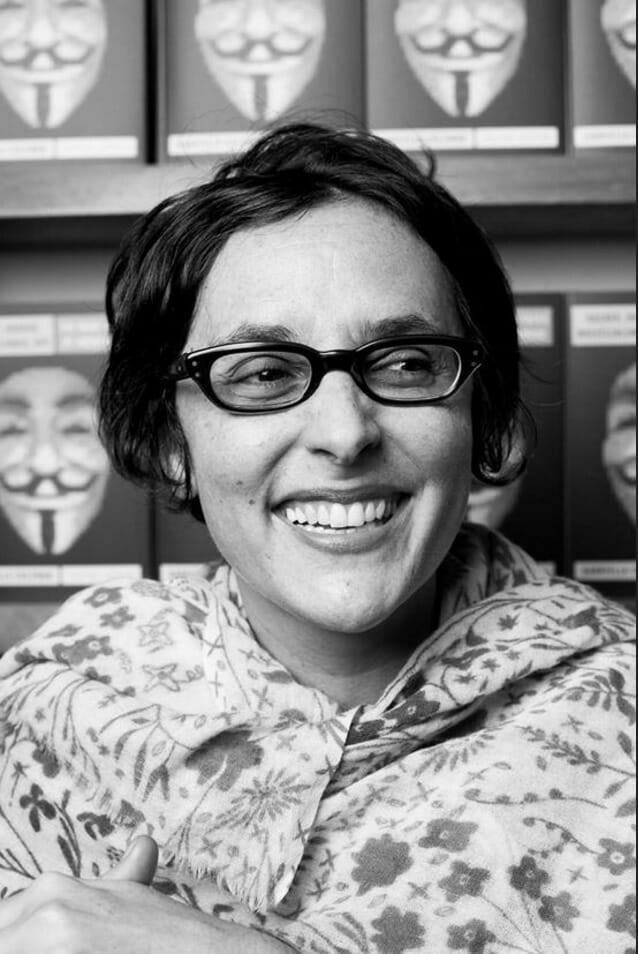
 Gabriella (Biella) Coleman holds the Wolfe Chair in Scientific and Technological Literacy at McGill University. Trained as a cultural anthropologist, she researches, writes, and teaches on computer hackers and digital activism. Her first book Coding Freedom: The Ethics and Aesthetics of Hacking has been published with Princeton University Press.
Her second book, Hacker, Hoaxer, Whistleblower, Spy: The Many Faces of Anonymous, published by Verso, has been named to Kirkus Reviews’Best Books of 2014 and has been awarded the 2015 American Anthropological Association’s Diana Forsythe Prize granted by the Society for the Anthropology of Work (SAW) and the Committee on the Anthropology of Science, Technology and Computing. (@biellacoleman)
Gabriella (Biella) Coleman holds the Wolfe Chair in Scientific and Technological Literacy at McGill University. Trained as a cultural anthropologist, she researches, writes, and teaches on computer hackers and digital activism. Her first book Coding Freedom: The Ethics and Aesthetics of Hacking has been published with Princeton University Press.
Her second book, Hacker, Hoaxer, Whistleblower, Spy: The Many Faces of Anonymous, published by Verso, has been named to Kirkus Reviews’Best Books of 2014 and has been awarded the 2015 American Anthropological Association’s Diana Forsythe Prize granted by the Society for the Anthropology of Work (SAW) and the Committee on the Anthropology of Science, Technology and Computing. (@biellacoleman)
 Peiter Zatko, better known as Mudge, is a computer and network security expert, open source programmer, writer, and a hacker. He ran one of the most famous hacker think tanks, the l0pht, and famously testified to the US Senate about catastrophic vulnerabilities within critical infrastructure in 1998.
Mudge has contributed significantly to disclosure and education on information and security vulnerabilities. In addition to pioneering buffer overflow work, the security work he released contained early examples of flaws in the following areas: code injection, race condition, side-channel attack, exploitation of embedded systems, and cryptanalysis of commercial systems. He was the original author of the password cracking software L0phtCrack.
In 2010 Mudge accepted a position as a program manager at DARPA where he oversaw cyber security R&D, and re-built the Agency’s approach to cyber security research. In 2013 Mudge went to work for Google and was Deputy Director of their Advanced Technology & Projects division.
He is the recipient of the Secretary of Defense Exceptional Civilian Service Award medal, an honorary Plank Owner of the US Navy Destroyer DDG-85, and was inducted into the Order of Thor, the US Army’s Association of Cyber Military Professionals.
Peiter Zatko, better known as Mudge, is a computer and network security expert, open source programmer, writer, and a hacker. He ran one of the most famous hacker think tanks, the l0pht, and famously testified to the US Senate about catastrophic vulnerabilities within critical infrastructure in 1998.
Mudge has contributed significantly to disclosure and education on information and security vulnerabilities. In addition to pioneering buffer overflow work, the security work he released contained early examples of flaws in the following areas: code injection, race condition, side-channel attack, exploitation of embedded systems, and cryptanalysis of commercial systems. He was the original author of the password cracking software L0phtCrack.
In 2010 Mudge accepted a position as a program manager at DARPA where he oversaw cyber security R&D, and re-built the Agency’s approach to cyber security research. In 2013 Mudge went to work for Google and was Deputy Director of their Advanced Technology & Projects division.
He is the recipient of the Secretary of Defense Exceptional Civilian Service Award medal, an honorary Plank Owner of the US Navy Destroyer DDG-85, and was inducted into the Order of Thor, the US Army’s Association of Cyber Military Professionals.